


Your email list size means nothing if every message gets ignored. In crowded inboxes, the real opportunity for growth lies in making every email feel like a one-on-one conversation, not a mass broadcast.
This guide covers the essential strategies for turning your email program into a predictable revenue engine. You’ll learn the data types that power personalization, proven tactics for increasing engagement, and how AI can automate and optimize your campaigns.
Try monday campaignsKey takeaways
- Personalized emails drive measurable revenue growth by delivering relevant content that increases open rates, click-through rates, and conversions compared to generic campaigns.
- Start with behavioral data like website visits and email clicks rather than just demographics — actions reveal what customers actually want to buy.
- Focus on proven tactics like behavioral triggers, dynamic content blocks, and predictive send times before moving to advanced AI strategies.
- Collect data responsibly by being transparent about usage, getting explicit consent, and only gathering information you’ll actually use for personalization.
- Combining AI-powered personalization with native CRM integration, monday campaigns lets you create sophisticated campaigns in minutes without technical expertise.
What is email personalization?
Email personalization is the practice of tailoring email content to individual recipients based on their data, behaviors, and preferences. This means each person on your list receives messages that feel custom-built for them — from subject lines that reference their recent actions to product recommendations based on their purchase history.
Think beyond just adding someone’s first name to an email. Modern personalization adapts entire messages based on where customers live, what they’ve bought, which pages they’ve visited, and when they typically open emails. When someone abandons their shopping cart, they get a reminder. When they download a whitepaper, they receive related content. When their subscription is about to expire, they see a renewal offer.
Why email personalization matters for revenue growth
Personalized emails directly impact your bottom line. When messages feel relevant and timely, recipients open them, click through, and buy. Research shows that personalization leaders commonly achieve 5–15% revenue lifts from these targeted approaches. This creates a clear path from email investment to revenue generation.
For example, a SaaS company that triggers follow-up emails after visitors view its pricing page could see a 22% lift in demo conversions — without increasing send volume. By responding to clear intent signals instead of blasting generic campaigns, the team tied personalization directly to pipeline growth.
But the benefits extend beyond individual campaign metrics. Here’s what personalization delivers for growing businesses:
- Measurable ROI: Track exactly how personalized campaigns drive conversions, customer lifetime value, and revenue per email.
- Marketing-sales alignment: Give sales teams detailed context about what content each lead engaged with, making follow-ups more effective.
- Resource efficiency: Create one dynamic template that adapts to different segments instead of building dozens of separate email campaigns.
For marketing leaders facing pressure to do more with less, personalization offers a path to greater impact. AI-orchestrated personalized programs have been shown to deliver 10–30% gains in marketing-spend efficiency, making every dollar work harder. You’re not just sending emails — you’re building relationships that drive predictable revenue growth.
5 key benefits of personalized email marketing
Personalized email marketing transforms how subscribers interact with your brand. When you send relevant messages at the right time, you create experiences that drive engagement and support business growth.
1. Increased click-through and conversion rates
Relevant content drives action. When you show winter coats to customers in cold climates or suggest products based on browsing history, you see immediate results. Recipients click more because the content matches their needs.
2. Enhanced customer experience and loyalty
Personalization makes customers feel recognized. They receive content aligned with their interests, not generic promotions. This recognition builds stronger relationships over time and increases the lifetime value of each customer.
3. Better data insights and campaign performance
Every personalized campaign generates valuable data about customer preferences. You learn what resonates with different segments, which helps refine future campaigns and inform broader marketing strategies.
4. Reduced unsubscribe rates
Relevant content keeps subscribers engaged. When people receive emails that match their interests and needs, they stay subscribed longer. This maintains healthier email lists and stronger deliverability.
5. Competitive advantage in crowded inboxes
Most people receive dozens of emails daily. Personalization helps your messages stand out by delivering unique value that generic emails can’t match. This differentiation captures attention and drives results.
With monday campaigns, these benefits become accessible through AI-powered personalization and native CRM integration. You can quickly create campaigns that adapt to each recipient while maintaining brand consistency.
Try monday campaigns7 email personalization tactics that drive real results
Effective personalization doesn’t require complex technology or massive budgets. Start with proven tactics that deliver measurable impact, then expand as you see results.
1. AI-powered subject line personalization
Subject lines determine whether emails get opened. AI analyzes individual subscriber behavior to optimize subject lines — selecting words that resonate, personalizing based on past opens, and timing sends when recipients are most active.
Move beyond basic name insertion. Reference recent actions, mention relevant products, or highlight timely offers. “Your cart is waiting” outperforms “Check out our products” every time.
2. Dynamic content blocks
One email template can serve multiple audiences through dynamic content blocks. These sections automatically change based on subscriber data — showing different products, images, or offers to different segments.
This approach saves time while delivering personalized experiences at scale. Marketing teams using monday campaigns can create sophisticated dynamic emails without technical expertise.
3. Behavioral trigger campaigns
Automated emails triggered by specific actions deliver perfect timing. Common triggers that drive results include:
- Cart abandonment: Remind shoppers about items they left behind
- Post-purchase: Thank customers and suggest complementary products
- Content downloads: Follow up with related resources
- Re-engagement: Win back inactive subscribers with special offers
These campaigns work because they respond to demonstrated interest with relevant content.
4. Personalized product recommendations
Sophisticated recommendation engines analyze browsing history, purchase patterns, and similar customer profiles to suggest relevant products. This goes beyond generic “you might also like” sections to deliver truly personalized suggestions.
For B2B companies, this might mean recommending content based on industry and role. For e-commerce, it means showing products that match individual style preferences and purchase history.
5. Lifecycle stage messaging
Tailor content to where customers are in their journey. New subscribers need welcome content and education. Active customers appreciate loyalty rewards and exclusive offers. At-risk customers respond to win-back incentives.
This ensures every email delivers value appropriate to the relationship stage.
6. Location and time-based content
Geographic personalization makes emails feel immediate and relevant. Promote local events, adjust for weather conditions, or highlight region-specific offers. Combine this with send-time optimization to reach subscribers when they’re most likely to engage.
7. Predictive send time optimization
AI analyzes when each subscriber typically opens emails, then automatically sends at their optimal time. This improves open rates without creating new content — same email, smarter delivery.

Essential data types for email personalization
Quality data powers effective personalization. The information you collect determines how well you can tailor messages to each subscriber. Focus on gathering data that directly improves campaign relevance.
Behavioral and engagement data
Actions speak louder than demographics. Track what subscribers do — which emails they open, what links they click, which products they view. This behavioral data reveals actual interests and helps you send timely, relevant follow-ups.
For example, someone who views pricing pages shows purchase intent. Someone who downloads beginner guides needs educational content. These signals guide your personalization strategy.
Demographic and firmographic information
Basic details like location, age, and job title enable targeted messaging. Location data powers weather-based promotions or event invitations. Job titles help B2B marketers speak directly to different roles and pain points.
Keep demographic collection minimal and purposeful. Only ask for information you’ll actually use in campaigns.
Purchase history and CRM data
Past purchases reveal preferences and predict future behavior. Use this data to recommend complementary products, time renewal reminders, or win back lapsed customers. CRM data adds context about the full customer relationship beyond just email interactions.
Zero-party preferences and interests
Information subscribers willingly share is gold. When someone tells you their preferred product categories or email frequency through surveys or preference centers, they’re explicitly stating what they want to receive.
How to collect quality data for personalized emails
Smart data collection balances thoroughness with user experience. You need enough information to personalize effectively without creating friction or privacy concerns.
Smart email sign-up forms
Design forms that collect useful data without overwhelming new subscribers. Start with essentials like name and email, then use progressive profiling to gather more details over time.
Consider asking one relevant question during sign-up — preferred content topics, industry, or company size. This immediately enables basic personalization while keeping the process simple.
Website and email tracking
Behavioral tracking happens automatically in the background. Monitor which pages subscribers visit, what content they download, and how they interact with your emails. This passive collection builds rich profiles without requiring any effort from subscribers.
CRM integration and data flow
Connect your email platform with your CRM for a complete customer view. This integration combines behavioral data with purchase history, support interactions, and sales conversations.
Interactive preference centers
Let subscribers control their experience through self-service preference centers. They can update interests, choose email frequency, and select content topics. This improves data accuracy while reducing unsubscribes — people who can customize their experience are more likely to stay engaged.
Common personalization mistakes that hurt conversions
Personalization can increase conversions — but when it’s poorly executed, it does the opposite. These are the most common mistakes that quietly undermine performance:
- Relying on demographics instead of intent: Job titles and locations provide context, but they don’t signal readiness to buy. Without behavioral data, personalization often misses timing and relevance.
- Over-automating early-stage relationships: Triggering too many emails before trust is established can feel intrusive rather than helpful, leading to disengagement or unsubscribes.
- Personalizing without sales context: Emails that ignore CRM data — such as deal stage, recent conversations, or objections — create disjointed customer experiences.
- Collecting more data than you can use: Excess data increases complexity without improving results. Effective personalization focuses on a few high-signal inputs, not everything available.
- Treating personalization as a one-time setup: Subscriber behavior changes. Campaigns that aren’t continuously optimized quickly lose relevance.

AI-driven personalization works best when it’s applied in layers. Instead of jumping straight to complex automation, successful teams build capabilities progressively — starting with optimization, then prediction, and finally real-time adaptation.
These 3 capability tiers show how AI enhances personalization at scale:
- Foundational AI optimization: Automates improvements to existing campaigns, such as subject line testing, send-time optimization, and basic content adjustments based on engagement history.
- Predictive AI personalization: Uses behavioral patterns to anticipate future actions — identifying who is likely to convert, churn, or upgrade — and adjusts messaging proactively.
- Adaptive, real-time optimization: Continuously monitors performance during active campaigns and dynamically adjusts subject lines, content blocks, and delivery timing to maximize results mid-send.
The right approach depends on your current capabilities and goals — but every tier delivers measurable improvements over static, one-size-fits-all campaigns.
Try monday campaignsHow to implement email personalization in 6 steps
A systematic approach ensures successful implementation. Follow these steps to build a personalization program that scales with your business.
Step 1: Audit your current email data
Review what subscriber information you have and assess its quality. Check for completeness, accuracy, and relevance. Identify gaps that limit personalization opportunities.
Use this audit to prioritize data collection efforts and determine which personalization tactics you can implement immediately.
Step 2: Define clear personalization goals
Set specific objectives tied to business outcomes. Are you aiming to increase open rates by 20%? Improve conversion rates? Reduce unsubscribes?
Clear goals guide your strategy and help demonstrate ROI to stakeholders. For example, you might aim to increase conversions from a specific segment or improve customer lifetime value through targeted follow-ups.
Step 3: Select your technology stack
Choose platforms based on your team’s needs and technical capabilities. Consider how well solutions integrate with existing systems and whether they can scale with your growth.
With monday campaigns, you can simplify this decision by combining email, CRM, and AI in one platform designed for marketing teams.
Step 4: Build smart segmentation strategy
Start with broad segments based on available data, then refine over time. Common starting segments include:
- Engagement level: Active vs. inactive subscribers
- Customer status: Prospects vs. customers
- Geographic location: Regional targeting
- Behavioral patterns: Content preferences or purchase history
Focus on creating meaningful segments that directly improve campaign results while keeping management straightforward.
Step 5: Create dynamic email templates
Design flexible templates with modular content blocks. This allows personalization without creating entirely new emails for each segment.
Balance customization with brand consistency — personalized doesn’t mean off-brand.
Step 6: Test, measure, and optimize
Launch with small tests, measure results, and scale what works. Track key metrics and use insights to refine your approach continuously.
Software like monday campaigns provides built-in analytics and AI-powered recommendations that make optimization automatic.
Measuring personalized email campaign success
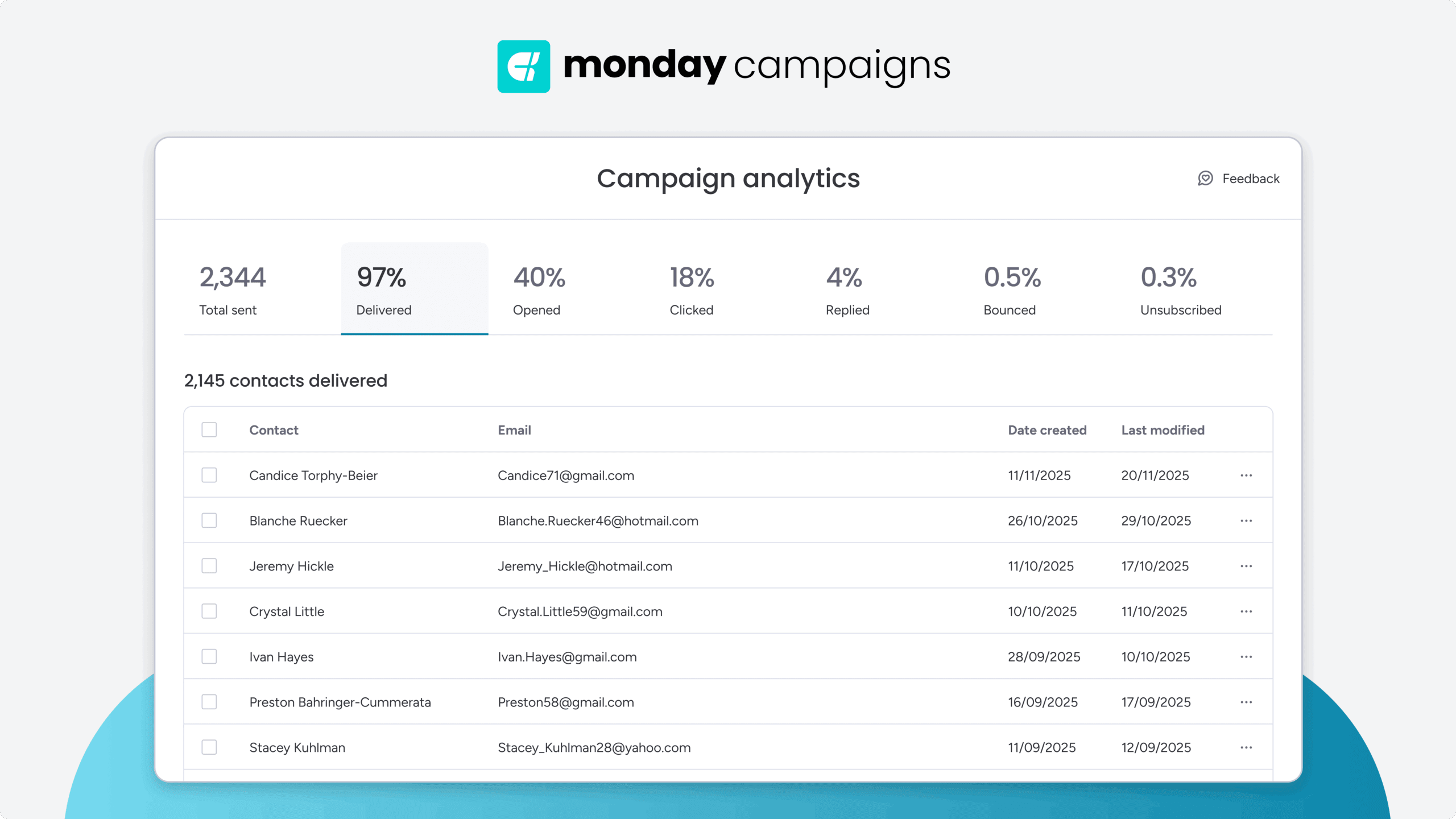
Measurement proves personalization’s value and guides improvement. Focus on email personalization metrics that connect email performance to business outcomes.
Track these key metrics to understand how personalization drives results:
| Metric | What it measures | Why it matters for personalization |
|---|---|---|
| Open rate | Percentage of recipients who open your email | Shows whether personalized subject lines and send times capture attention |
| Click-through rate | Percentage of recipients who click links within your email | Reveals if content relevance matches subscriber interests and needs |
| Conversion rate | Percentage who complete desired actions | Demonstrates whether personalization drives actual business outcomes |
| Revenue per email | Average revenue generated per message sent | Directly connects personalization efforts to bottom-line impact |
| Customer lifetime value | Total revenue from a customer over time | Shows how personalization builds stronger, longer-lasting relationships |
| Unsubscribe rate | Percentage who opt out after receiving emails | Indicates whether personalization improves relevance or misses the mark |
| Lead quality score | Engagement level of prospects generated | Measures whether personalization attracts the right audience |
Compare personalized campaigns against generic ones to demonstrate impact. Document improvements in engagement and revenue to build support for expanded personalization efforts.
Pro tip: If you can only track three metrics, start with conversion rate, revenue per email, and unsubscribe rate.
Email personalization best practices for privacy compliance
Privacy and personalization work together to build trust and deliver relevant experiences. Following best practices builds trust while delivering relevant experiences.
Key principles for responsible personalization:
- Transparent data collection: Explain what information you gather and how you use it
- Explicit consent: Get clear permission before collecting and using data
- Minimal data requirements: Only collect what you need for meaningful personalization
- Easy preference management: Let subscribers control their data and communication preferences
- Secure data handling: Protect subscriber information with appropriate security measures
First-party data strategies work best. Information subscribers share directly with you is more accurate and compliant than purchased lists. Build relationships that encourage voluntary data sharing through value exchange — exclusive content, personalized recommendations, or member benefits.

Enterprise-grade personalization shouldn’t require enterprise-level resources or technical expertise. That’s the core philosophy behind monday campaigns — a platform designed to make sophisticated email marketing accessible to teams of all sizes.
By combining AI capabilities, native CRM integration, and intuitive design, it removes the barriers that typically prevent marketers from executing truly personalized campaigns at scale.
Here’s what sets this approach apart:
- AI that works immediately: No lengthy training periods or complex setup processes. The AI starts optimizing subject lines, send times, and content from your very first campaign, learning and improving with each send.
- Unified customer view: Native CRM integration means your email campaigns automatically connect to customer data across the entire lifecycle — from first website visit to latest purchase. No manual data syncing, no disconnected systems.
- Speed without sacrifice: Launch personalized campaigns in minutes, not days. Dynamic content blocks, behavioral triggers, and predictive segmentation are built-in features, not add-ons that require developer support.
- Real-time optimization: Campaigns don’t just send and wait. The platform continuously monitors performance and adjusts elements mid-campaign to maximize engagement and conversions.
- Scalable sophistication: Start with basic personalization and expand into advanced AI-driven strategies as your needs grow. The same intuitive interface supports both simple and complex campaigns.
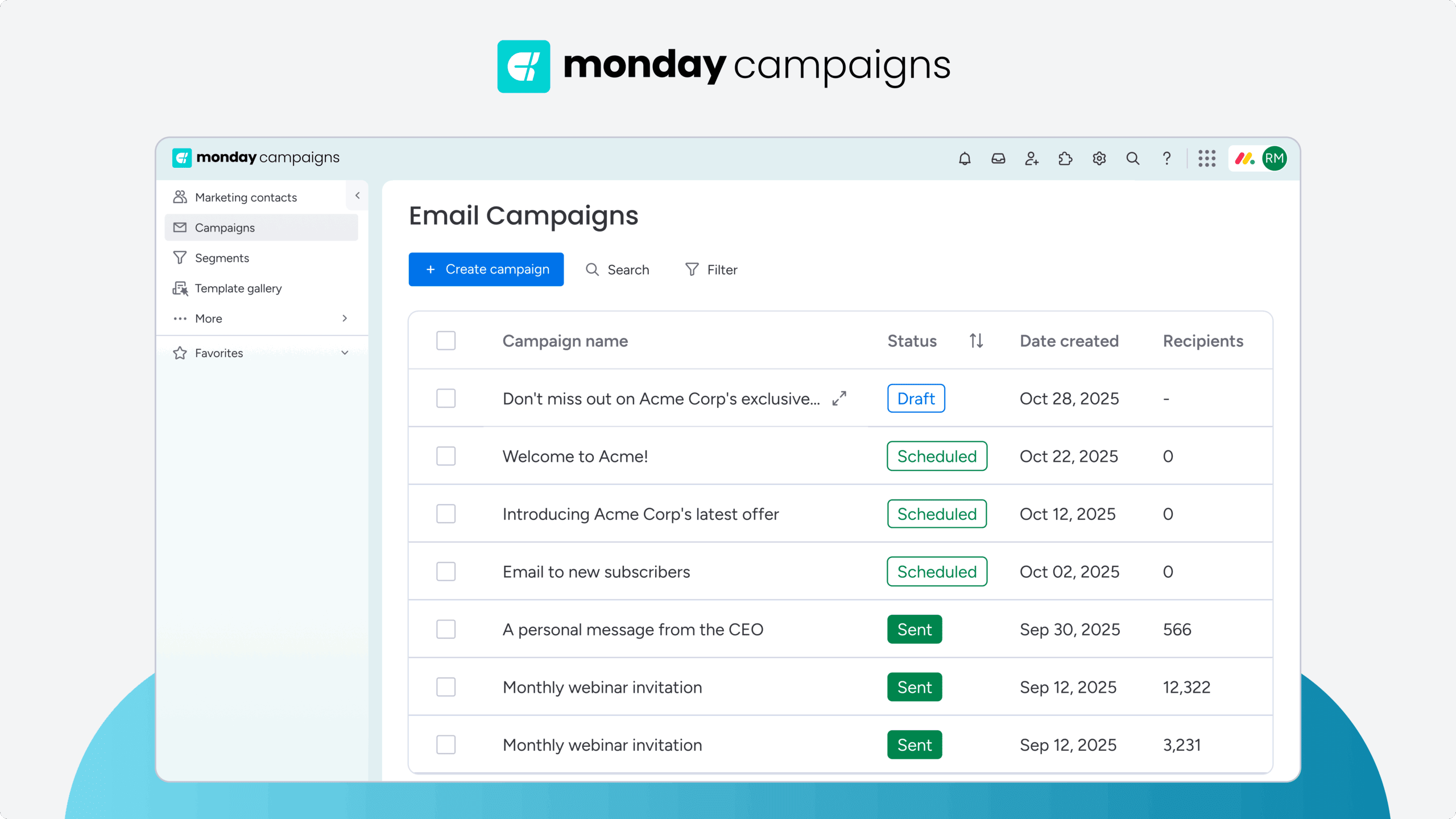
The platform handles the technical complexity while you focus on strategy and creativity. From AI-powered subject lines to automated content generation and predictive audience segmentation, advanced personalization becomes accessible to every marketer — regardless of technical background. What once required dedicated data scientists and developers now happens through an intuitive interface designed for marketing teams.
Start personalizing your emails today
Email personalization transforms generic broadcasts into revenue-driving conversations. By leveraging behavioral data, implementing proven tactics like dynamic content and trigger campaigns, and using AI to optimize at scale, you create experiences that subscribers actually want to engage with.
With AI-powered optimization, native CRM integration, and intuitive tools that work from day one, monday campaigns lets you launch personalized campaigns fast. No technical expertise required, no lengthy setup processes — just powerful personalization that drives real business results.
Try monday campaignsFAQs
How quickly can I see ROI from personalized emails?
Most businesses see initial ROI from personalized emails within 30 to 90 days, depending on data quality and implementation speed.
What's the difference between email segmentation and personalization?
Email segmentation groups subscribers by shared characteristics, while personalization customizes content for each individual — both work together but serve different purposes.
Can small businesses implement email personalization effectively?
Small businesses can absolutely implement email personalization using modern platforms that make advanced features accessible without technical expertise or large budgets.
How much do email personalization tools typically cost?
Email personalization tool costs vary widely based on features and list size, but many platforms offer scalable pricing that grows with your business needs.
Which personalization tactics work best for B2B versus B2C?
B2B personalization typically focuses on job role, industry, and company size, while B2C emphasizes purchase behavior and personal preferences — both benefit from behavioral triggers.
How do I personalize emails without violating privacy regulations?
Personalize emails compliantly by obtaining explicit consent, being transparent about data use, and collecting only necessary information while providing easy opt-out options.

 Get started